
Doniphan Parole and Probation
Parole and probation both allow a person to live outside a correctional institution under rules, but they begin in different ways. Parole is supervised release from an eligible prison sentence. Kansas also uses conditional release and postrelease supervision for other state sentence structures. Probation usually begins with a Doniphan County court order and serves as an alternative to confinement or as the community part of a disposition. A person on probation is not automatically a former KDOC prisoner.
The source should match the status. KASPER, the Kansas Adult Supervised Population Electronic Repository, is the main public source for KDOC custody, parole, conditional release, postrelease supervision, and discharge. The Doniphan District Court docket is more useful for a county probation order. KASPER warns that some community-corrections events after April 21, 2021 may not display while systems are modernized, so an absent probation entry calls for agency or court confirmation.
| Point | Parole or postrelease | Probation |
|---|---|---|
| How it starts | Follows a KDOC prison sentence or eligible parole decision | Ordered by the sentencing court |
| Primary public record | KASPER status and supervising office | Court docket, order, and community-corrections contact |
| Physical custody | Person is generally outside prison but still supervised | Person serves the court disposition in the community |
| Completion | KASPER discharge and, when applicable, a discharge certificate | Court or supervising agency discharge order |
- Parole
- Supervised community release granted in an eligible prison case.
- Postrelease supervision
- A required supervised term after the prison part of a determinate sentence.
- Probation
- A court-ordered community sentence with conditions.
- Discharge
- Completion of the sentence or supervision, not merely release from a building.
Verify Doniphan Post-Release Supervision
Start with identity and sentence type, not a broad assumption. A Doniphan County Jail booking followed by bond, dismissal, time served, or local probation may never create a KDOC record. By contrast, a transfer from the jail to KDOC can make KASPER useful after state intake. Use the full name, date of birth when available, case number, booking number, or KDOC number to separate people with similar names.
- Search KASPER by name or KDOC number. Refine by Doniphan as conviction county or parole-supervision county only when that fact fits the case.
- Read the whole record. “Parole,” “conditional release,” or “postrelease supervision” signals release from prison with active supervision. “Discharged” signals completion of the displayed KDOC sentence.
- Check the listed parole office. A conviction in Doniphan County does not prove that the person returned to or is supervised in Doniphan County.
- For probation, review the Doniphan District Court disposition and current order. Contact the named community-corrections agency if the online state record is incomplete.
- When the sources conflict, ask the office maintaining the active case. An old docket explains the sentence but does not prove present supervision.
The Doniphan County released-inmate search and records path explains how to verify the earlier jail exit. That county release event should not be used as a substitute for a current parole, postrelease, or probation record.
The KDOC locating guidance identifies the state fields and explains that KASPER covers sentenced people who are incarcerated, supervised after prison, or discharged. Its current status matters more than a date viewed alone. A movement entry can also describe transfer rather than freedom.
The official KDOC field guidance is shown below through its locating-a-resident source.

The image reinforces that supervision, anticipated release, movement, and discharge are separate record fields that must be read in context.
Important: A person can be released from prison and still be on parole or postrelease supervision. Only final discharge ends the KDOC sentence shown.
Doniphan County Parole Office
Doniphan County does not have its assigned KDOC parole office in Troy. The official regional assignment sends Doniphan cases to the Atchison Parole Office in the North Region. That office also serves Atchison, Brown, and Nemaha counties. This distinction matters when a KASPER record shows active state supervision and the reader needs the responsible field office rather than the Doniphan County Jail.
Atchison Parole Office, North Region729 Kansas Avenue
Atchison, KS 66002
913-804-6110
Serves Atchison, Brown, Doniphan, and Nemaha counties
The KDOC parole-office directory is the official source, but it was observed redirecting to a login during research. Use the phone and address above if the directory is not publicly visible. Office assignment can change with residence, transfer, compact supervision, or a new case, so compare the contact with the current KASPER record.
Questions about release-date math belong elsewhere. KDOC's Sentence Computation Unit handles official state computations, while the Atchison office deals with assigned field supervision. A Doniphan court or community-corrections contact remains the proper route for probation that did not follow a KDOC prison term.
Note: The Atchison assignment is a supervision route, not proof that every released Doniphan County person must report there.
Doniphan Absconders and Warrants
Doniphan County has two locally relevant alert paths that must not be blended. The Sheriff publishes an outstanding-warrant list. KASPER publishes separate parole and community-corrections absconder lists. An absconder is a person whom supervision officials report as out of required contact or status. That label is not, by itself, a court-certified warrant and does not prove present jail or prison custody.
Search the KASPER parole absconder list or the community-corrections absconder list only for the status each source states. Then verify a claimed warrant through the issuing court or the Doniphan County Sheriff warrant page. Name matches need care, especially when aliases or common names appear.
The official warrant channel is illustrated through the Doniphan County outstanding-warrants source.
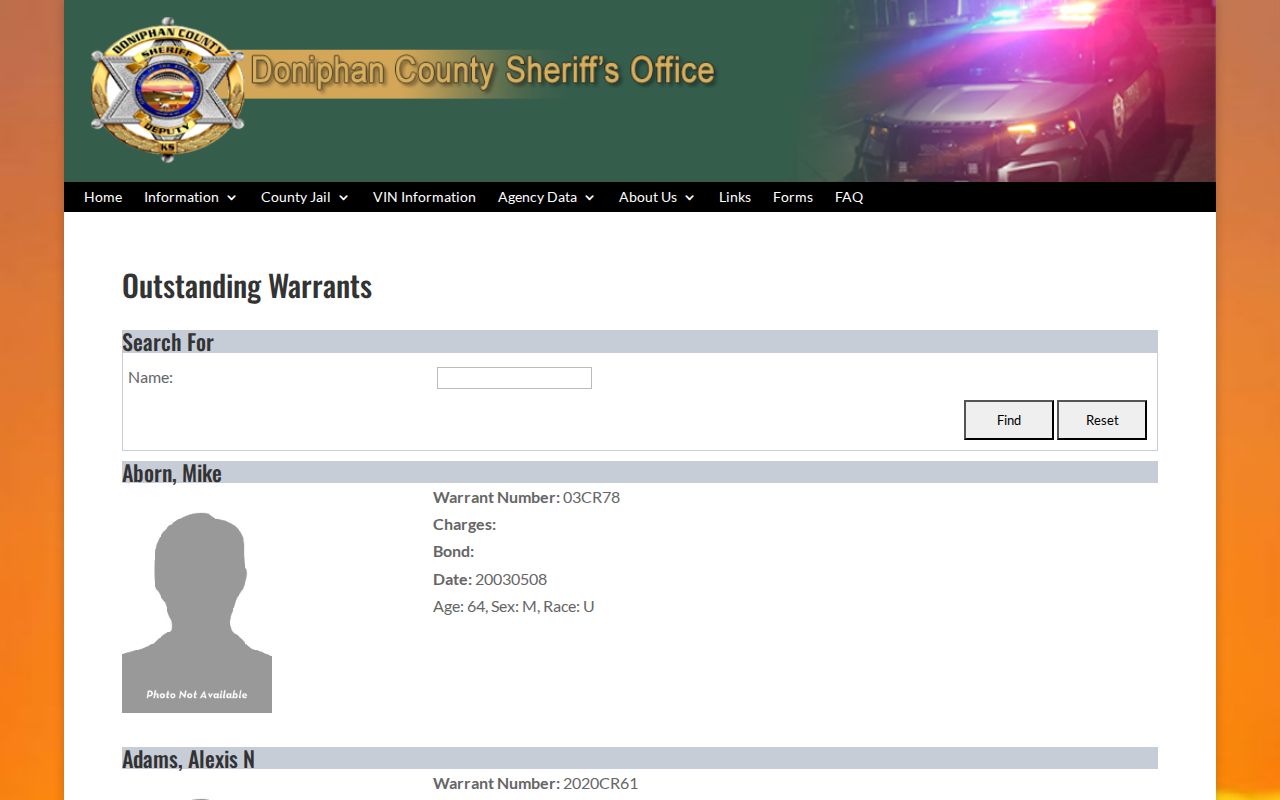
The county image shows why a warrant record must remain separate from KASPER supervision and absconder information.
A warrant, an absconder record, and an incarceration record answer three different questions. None should be used to announce that someone was recently released. For urgent current-custody verification, contact the jail or the agency shown on the record.
Doniphan Supervision Status Changes
Conditions are the rules attached to community supervision. Their exact terms come from the controlling court order, release certificate, or supervising agency. Public sources can show broad status, but they do not replace the person's written conditions. A reported violation may lead to review, changed conditions, arrest, or revocation proceedings. It does not erase the need for an official outcome.
For eligible old-law cases, the Kansas Prisoner Review Board process uses the terms “parole,” “continue,” and “pass.” Parole means the person was found suitable, continue means a decision was postponed for more information or deliberation, and pass means the person was not found suitable for a stated interval. Most post-1993 determinate guidelines cases do not receive a discretionary parole date. Their prison portion ends under sentence computation, although the Board may set release conditions.
The public-comment calendar and its linked upcoming-person list describe the hearing pipeline. Appearance on that list means eligibility consideration is approaching. It is not a grant, a release record, or a current person-level decision result. No public individual PRB decisions search was verified in the research. KASPER status after the event is the practical public check.
The decision terminology can be checked against the official Prisoner Review Board process source.

The source distinguishes a grant from a delayed or unsuccessful suitability decision, which prevents an upcoming hearing from being misreported as release.
Doniphan Post-Release Registration
Some people under Kansas law also have offender-registration duties after release. This is not a rule for all released people, and the registry is not a parole or probation list. For those who are legally required to register, the Doniphan County Sheriff publishes a concrete local paperwork route.
The Sheriff's registration instructions state that routine service is available Monday through Friday from 8:00 a.m. to 5:00 p.m. After-hours or weekend registration is by appointment. A new registrant should bring a driver's license and relevant court papers. The page states that initial registration has no charge and that a $20 update fee applies for each required registration month.
Those local steps apply only when the Kansas Offender Registration Act covers the person. A registry entry may confirm a published registration record, but it cannot supply the Doniphan jail release time or prove when parole or probation began. Likewise, an update date is an administrative date, not a release date.
Note: Confirm current paperwork, appointment access, and fees with the Sheriff before travel because operational details can change.
Doniphan Supervision and Discharge
Release from a cell and discharge from a sentence are not the same event. A person on parole, conditional release, or postrelease supervision remains subject to KDOC authority while living outside prison. A probationer remains bound by the court and supervising agency until the court or responsible office ends that term. The record that proves completion depends on which sentence was imposed.
K.S.A. 22-3722 provides for final discharge and a certificate after satisfactory completion or sentence expiration in covered parole or conditional-release cases. The statute generally allows final discharge after satisfactory performance, not less than one year after release unless the sentence expires sooner. The exact record and timing must be read for that person.
For KDOC supervision, a KASPER “discharged” status is stronger evidence of completion than “parole” or “postrelease supervision.” Review all active and inactive cases because one completed case can coexist with another active sentence. For probation, seek the court's discharge order or the supervising agency's completion record. A prior jail release entry alone cannot prove either form of completion.