
Doniphan Projected Versus Actual Release
KDOC's official term is “Anticipated release date.” It is a forward-looking sentence computation for a covered state record. It is not an observed release, a guarantee, or a promise of a door time. After that date, read current status, movement history, supervision, and discharge fields to learn what actually occurred. A person can move from prison to parole or postrelease supervision, transfer to another authority, remain in custody after a change, or complete the sentence.
Doniphan County Jail publishes no projected or anticipated date on its live roster. The roster shows booking facts for people currently held, but it does not show a release date, release reason, court outcome, or destination. A pretrial detainee may leave after bond is posted or a court acts, yet the amount displayed as bond does not prove payment or predict timing. For a local sentence, the journal entry, jail credit, holds, and the jail's actual computation control.
| Record | What it can establish | What it cannot establish alone |
|---|---|---|
| KASPER anticipated date | KDOC's current forecast for a covered sentence | That release occurred |
| Jail roster | Current Doniphan County custody at the time viewed | A future date or reason for removal |
| Court journal entry | Sentence, order, and legal terms | Exact physical exit without custody confirmation |
| Movement or discharge status | Later state custody or sentence-completion event | A county-only release when no KDOC sentence exists |
Find Doniphan Projected Release Dates
First determine whether the person is a county detainee, a county-sentenced inmate, or a KDOC prisoner. These groups use different date sources. A person whose only custody event was at Doniphan County Jail may never appear in KASPER. A person transferred from the jail to KDOC may begin appearing after state intake. The Doniphan County released-inmate lookup provides the broader custody path when the destination is unknown.
- Check the Doniphan County current-inmate roster once. If the person is listed, save the booking number, case clues, arresting agency, and booking date.
- Search the court record. For a pretrial case, read bond and recent orders. For a sentence, obtain the journal entry and any later amended order.
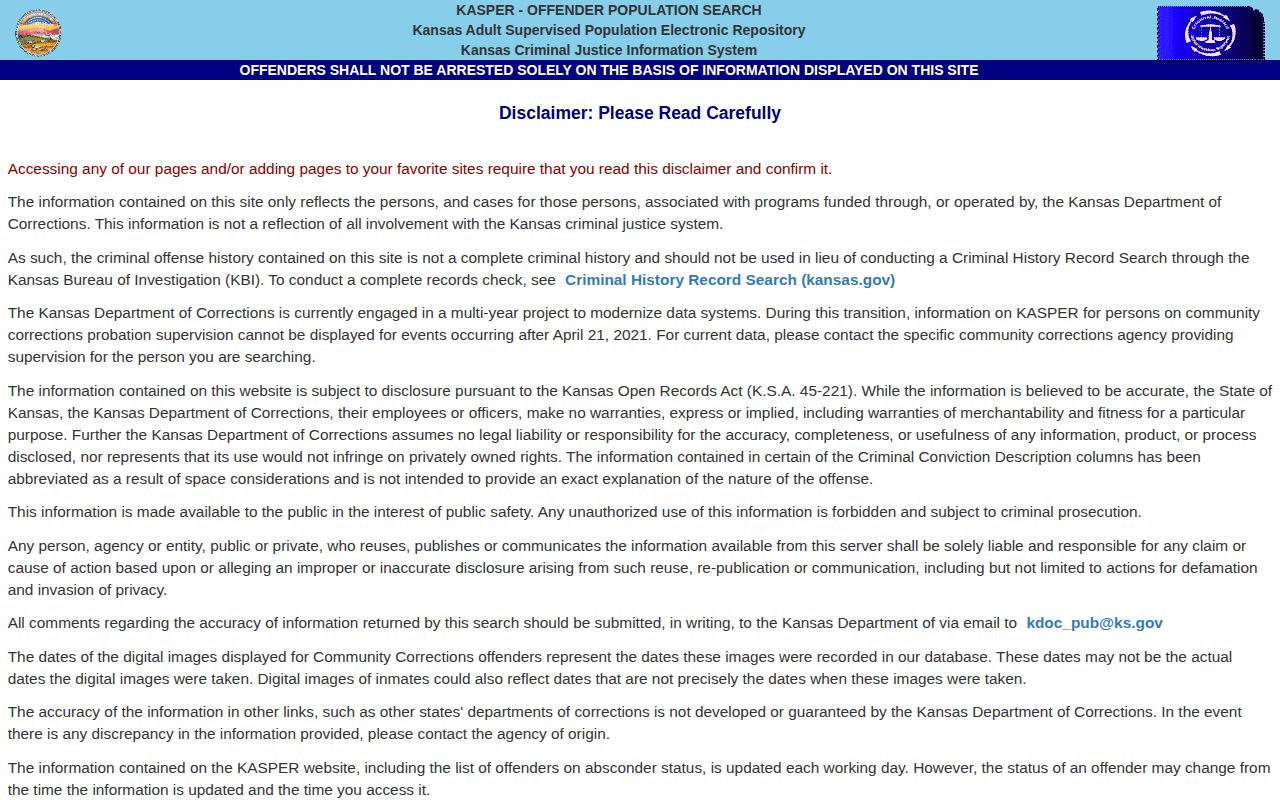
- If state custody is documented, open the KASPER search disclaimer, agree, and search by name or KDOC number.
- Read “Anticipated release date” with current housing, movement, sentence, and supervision fields. Do not isolate the date from the rest of the record.
- For a county jail computation, call the Doniphan County Jail at 785-985-3711 and ask for the existing custody or release chronology. Use the court for the controlling order.
- For an official KDOC computation question, contact the Sentence Computation Unit at 785-296-3317. Charge text alone is not enough to recalculate a sentence.
KASPER supports name, alias, KDOC number, KBI number, birth date or age range, race, gender, conviction county, and parole-supervision county. Selecting Doniphan as conviction county identifies the county tied to the conviction, not the person's residence or planned return county. Common names require more identifiers.
The KASPER offender search is shown in the successful project capture below.
The search is appropriate for KDOC-covered sentences, not for every person booked at Doniphan County Jail.
Doniphan KDOC Release-Date Fields
KASPER covers people sentenced to the Secretary of Corrections since 1980 who are incarcerated, supervised after prison, or discharged. KDOC says data update daily except weekends. People sent to Kansas under an interstate compact are excluded, and the search is not a complete arrest history. Those boundaries explain why “not found” cannot be turned into a release conclusion.
A state result can contain far more than one date. Read the set of fields together so a future estimate is not mistaken for a completed event.
| Field | How it helps |
|---|---|
| Current status | Distinguishes incarcerated, supervised, and discharged states |
| Anticipated release date | Shows KDOC's current forward-looking computation |
| Current housing and movements | Shows location and transfers that may affect interpretation |
| Conviction county and case | Connects the state record with the Doniphan court case when applicable |
| Supervision type and office | Shows parole, conditional release, postrelease, or compact supervision |
| Discharge information | Signals completion of the displayed KDOC sentence |
The KDOC locating guidance documents the anticipated-date and discharged-person coverage.

The field inventory supports using a later status and movement record to confirm what followed the forecast.
Note: KASPER updates do not make an anticipated date a live countdown, and weekend timing may affect when a changed status appears.
Doniphan Kansas Good-Time Rules
K.S.A. 21-6821 authorizes KDOC good-time and eligible program credits for sentencing-guidelines imprisonment. For crimes committed on or after July 1, 1993, the general maximum good-time credit is 15 percent of the prison portion. That is the source of the common “serve 85 percent” shorthand when all available credit is earned.
The shorthand is not universal. Certain lower-severity nondrug crimes committed on or after January 1, 2008 can receive a maximum of 20 percent, and specified drug severity categories and date ranges also use a 20 percent maximum. Eligible program credits can reduce qualifying terms by up to 120 days under statutory categories and exclusions. Credits may be earned, withheld, forfeited, or restored. Special and off-grid sentences can follow different rules.
For determinate guidelines cases, the Prisoner Review Board explanation says postrelease supervision starts at the maximum prison term less earned good time. The Board may set conditions, but K.S.A. 22-3717 does not let it advance or delay that determinate date. Credited time is generally added to the supervision component, so it does not simply erase the whole sentence structure.
Good-time note: Fifteen percent is a general maximum for many guidelines cases, not a guaranteed deduction and not a Doniphan County jail formula.
Doniphan Old-Law Release Dates
Older indeterminate sentences use parole eligibility rather than a single guidelines formula. Eligibility generally follows the minimum sentence less applicable credit, but offense date, offense type, and statutory exceptions matter. The PRB process states that a minimum of two years or more can receive one day of credit per day served toward the minimum, which can lead to half-minimum eligibility if all credit is earned. A one-year minimum reaches eligibility after nine months.
Conditional release for relevant indeterminate terms may occur at half the maximum if credit has not been lost. Off-grid and specified serious cases can have fixed waits or no deduction. A scheduled hearing does not mean release was granted. Kansas uses “parole” for a suitability grant, “continue” when decision work is postponed, and “pass” when suitability is not found for a stated interval.
The PRB public-comment calendar and upcoming-person list show a hearing pipeline, not a public individual results database. No current person-level PRB decision search was verified. After the proceeding, use KASPER's current status and supervision fields. Never apply the 85-percent shorthand to an old-law parole case.
The official release mechanics are visible in the Prisoner Review Board process source.

The source helps separate a discretionary suitability outcome from the computed date used in a determinate guidelines case.
Doniphan Jail Release Computation
No official Doniphan County Jail good-time policy was found in the reviewed Sheriff materials. No weekend-release rule, regular release hour, release door, or published release schedule was found either. Those absences are important. KDOC's prison credit formula must not be copied onto a county jail sentence.
A Doniphan County computation can turn on the court's journal entry, jail credit already awarded, concurrent or consecutive case terms, later court orders, and other holds. Obtain the journal entry from the Doniphan District Court. Then ask the jail for its existing custody chronology or date computation. If a transfer to KDOC occurs, KASPER and the state Sentence Computation Unit become the proper sources after intake.
Pretrial custody follows a different path. Bond may change, a court may order release, a charge may be dismissed, or another jurisdiction may maintain a hold. The live roster's bond amount does not establish that bond was posted. A name disappearing from the current list does not reveal whether the person returned to the community or moved to another authority.
Note: Call the jail for urgent current status, but obtain the written jail and court records when the date or legal basis must be documented.
Why Doniphan Release Dates Change
An anticipated release date changes when the data or credits used in the official computation change. Some events move the forecast. Others change where the person goes without changing the sentence in a simple way. The current source should name the event before anyone draws a conclusion.
| Factor | Possible effect | Best confirmation |
|---|---|---|
| Good-time credit | Earned, withheld, forfeited, or restored credit changes the computation | KASPER and KDOC Sentence Computation Unit |
| Program credit | Eligible credit may reduce a qualifying prison term | Official KDOC computation |
| Discipline | Credit loss can move an anticipated date later | KDOC record and computation |
| Court order or corrected case data | Sentence terms or credit may be amended | Current journal entry and agency computation |
| Another sentence or hold | Release from one case may not end custody | Movement record and receiving jurisdiction |
| Old-law parole outcome | A pass or continue can delay possible parole | PRB process followed by KASPER status |
A detainer is a request or legal basis for another authority to retain or take custody. It can make a jail or prison exit a transfer rather than community release. That is why the destination field, movement history, and receiving-agency record matter as much as the date.
Confirm Doniphan Actual Release Dates
After the forecasted day, return to the system that held the person. For KDOC, read current status, movement history, supervision type, assigned office, and discharge information in KASPER. “Parole,” “conditional release,” or “postrelease supervision” means the person is physically outside prison but still supervised. “Discharged” means the displayed KDOC sentence has ended, subject to any other active case.
For Doniphan County Jail, Kansas VINE can report a county-jail custody change when participating data are present. Kansas VINE expressly excludes KDOC prison residents. A VINE released result does not state whether the event was bond, time served, dismissal, transfer, or another hold, so use the sheriff chronology and court docket for the reason and destination. Registration steps are covered on the VINELink Check page.
When records conflict, use the originating office. Ask the Sheriff for county custody details, the court for its order, KDOC for the state computation, and the receiving agency for a documented transfer. “Not found” in the wrong system is not a release type.